

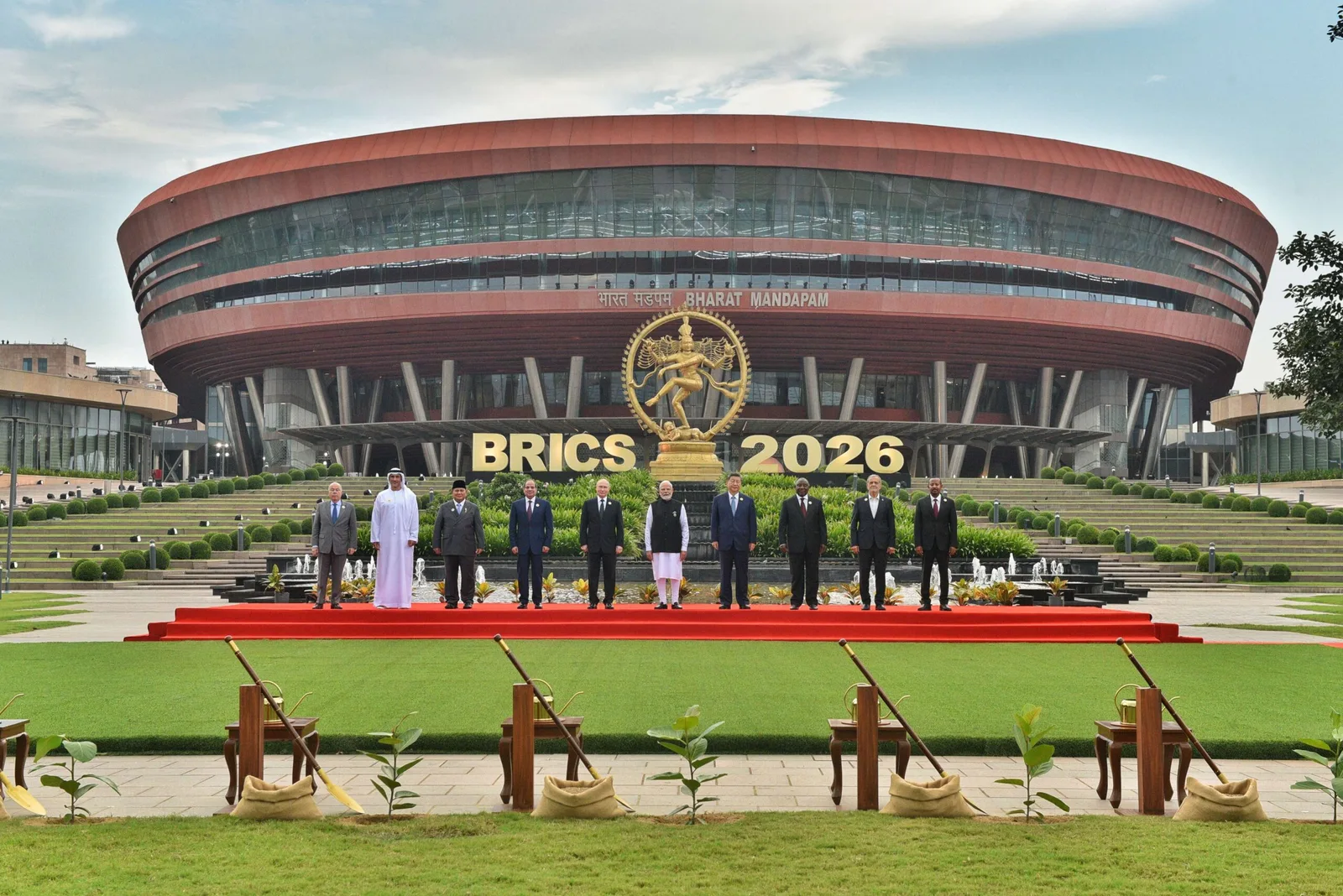
The 18th BRICS Summit, held in New Delhi under India’s chairship, concluded with the adoption of the New Delhi Declaration, outlining the collective position of member states on a wide range of international, economic, technological and security-related issues.
The declaration addresses several contemporary challenges, including reform of global governance institutions, international trade, financial cooperation, terrorism, artificial intelligence, cybersecurity, digital technologies, climate-related concerns and geopolitical conflicts. The outcomes reflect the expanding scope of BRICS as a platform for cooperation among emerging and developing economies.

BRICS and the Changing Global Order
The New Delhi Declaration reiterates the importance of multilateralism and international cooperation in addressing global challenges. BRICS members emphasised the need for an international system that provides greater representation to developing and emerging economies.
The grouping called for reforms in major international institutions to ensure that their decision-making structures more accurately represent current global economic and geopolitical realities. Particular attention was given to international financial institutions, including the International Monetary Fund and the World Bank.
 The declaration also reaffirmed the importance of the United Nations and its central role in maintaining international peace, security and cooperation.
Strengthening the Voice of the Global South
A recurring theme of the summit was the need to strengthen the participation of the Global South in international decision-making.
BRICS members emphasised that developing countries should have a greater role in shaping international economic, financial and political frameworks. Cooperation among developing economies was presented as an important mechanism for addressing shared challenges, including economic instability, technological inequality and sustainable development.
The declaration therefore positions BRICS not only as an economic grouping but also as an increasingly significant forum for articulating the interests of emerging and developing nations.
International Trade and Economic Cooperation
Economic cooperation remains one of the principal areas of BRICS engagement. The declaration expressed concern over unilateral trade measures that may disrupt international commerce, supply chains and economic stability.
Member states supported efforts to strengthen economic cooperation and improve the resilience of international trade. The declaration also emphasised the importance of creating conditions conducive to predictable and sustainable economic activity.
Greater cooperation in investment, trade facilitation and financial connectivity was identified as an important component of strengthening relations among BRICS economies.

Local Currencies and Cross-Border Payments
The declaration placed considerable emphasis on improving cross-border payment mechanisms and facilitating greater use of national currencies in transactions among member states.
The approach focuses on strengthening financial cooperation without establishing a common BRICS currency. Instead, member countries seek to improve existing payment infrastructure and mechanisms that can facilitate transactions in local currencies.
The initiative is significant in the context of efforts to improve financial resilience and reduce barriers to cross-border economic activity among BRICS members.

Counter-Terrorism Cooperation
Collective Response to Terrorism
Counter-terrorism featured prominently in the declaration. BRICS members reaffirmed their strong opposition to terrorism in all its forms and manifestations and emphasised the importance of international cooperation in preventing and combating terrorist activities.
The declaration stressed that counter-terrorism efforts should address not only terrorist attacks but also the broader infrastructure that enables terrorist organisations to operate.
Terrorist Financing and Networks
The grouping highlighted the importance of preventing terrorist financing, disrupting terrorist networks and denying terrorist organisations access to safe havens.
International cooperation, intelligence sharing and coordinated measures against terrorism were identified as essential components of an effective counter-terrorism framework.
The declaration also referred to the April 2025 Pahalgam terrorist attack, placing the issue within the broader context of international efforts to combat terrorism.
Artificial Intelligence and Responsible Technological Development
 AI as an Emerging Global Priority
Artificial intelligence was another significant area addressed by the BRICS countries. The declaration recognised the transformative potential of AI in areas including scientific research, economic development, public services and technological innovation.
However, member states also acknowledged that rapid developments in AI create new regulatory, ethical and security challenges.
Governance of Artificial Intelligence
BRICS supported the development of AI governance frameworks that promote safety, security, reliability, inclusivity and responsible innovation.
The declaration emphasised the importance of international cooperation in developing appropriate approaches to AI governance. It also recognised the need to ensure that developing countries are able to participate meaningfully in the AI ecosystem and benefit from technological advancements.

Cybersecurity and Digital Security
Growing Cyber Threat Landscape
The declaration acknowledged the increasing scale and complexity of digital threats. These include cybercrime, malicious software, data-security vulnerabilities and other forms of technology-enabled criminal activity.
The growing dependence of governments, financial institutions, businesses and individuals on digital infrastructure has made cybersecurity an important component of national and international security.
Misinformation, Disinformation and Deepfakes
BRICS also drew attention to emerging information-related threats, including misinformation, disinformation and deepfakes.
The increasing availability of technologies capable of generating or manipulating audio-visual material presents challenges for public communication, information integrity and institutional trust. Cooperation between countries was therefore identified as important in addressing such challenges.
International Cooperation on Cybersecurity
The declaration supports stronger cooperation among member states in areas such as information exchange, capacity building and technological development.
Such cooperation is intended to improve the ability of BRICS countries to prevent, detect and respond to cyber-related threats while strengthening the security and resilience of digital infrastructure.
Digital Technologies and Innovation
BRICS members recognised the importance of digital technologies in promoting economic growth and improving public services.
The declaration supported greater cooperation in areas including digital public infrastructure, emerging technologies, innovation and scientific research. These areas are particularly relevant to developing countries seeking to expand digital access and strengthen technological capabilities.
The emphasis on digital cooperation also reflects the increasing relationship between technological development, economic competitiveness and national resilience.

Science, Technology and Research Cooperation
Scientific and technological cooperation formed another important component of the summit’s agenda.
BRICS countries emphasised the value of collaboration in research, innovation and knowledge exchange. Greater cooperation in science and technology can facilitate the sharing of expertise, development of research capabilities and creation of joint solutions to complex global challenges.
The approach is particularly relevant in emerging fields where substantial investment, specialised knowledge and international collaboration are required.

BRICS Risk Lab at GIFT City
As part of India’s initiatives during its BRICS chairship, a proposal was advanced for establishing a BRICS Risk Lab at GIFT City, Gujarat.
The initiative is intended to contribute to cooperation and knowledge exchange concerning emerging risks. Such mechanisms could become increasingly important as countries confront interconnected economic, technological, environmental and security risks.
The proposal also reflects India’s broader effort to strengthen its role in financial, technological and institutional cooperation within the BRICS framework.
West Asia and International Conflicts
The summit also addressed major geopolitical developments and ongoing international conflicts.
BRICS members expressed concern regarding instability and conflict in different parts of the world and reiterated the importance of peaceful means for resolving disputes. Dialogue, diplomacy and respect for international law were emphasised as important mechanisms for addressing geopolitical tensions.
The declaration reflects the grouping’s broader position that international cooperation is necessary to address conflicts and their economic and humanitarian consequences.
Climate and Sustainable Development
Sustainable development and resilience also formed part of the broader BRICS agenda.
Member states recognised the need to pursue economic development while addressing environmental challenges and strengthening resilience against climate-related risks. Cooperation in sustainable development can assist developing countries in balancing economic growth with environmental protection.
The issue is particularly relevant for emerging economies that face significant developmental requirements alongside increasing climate-related vulnerabilities.
Implications for the Forensic and Cybersecurity Community
The declaration’s emphasis on cybersecurity, cybercrime, artificial intelligence, deepfakes, data security and digital technologies has particular relevance for the forensic science community.
The increasing use of sophisticated digital technologies is creating new challenges for digital forensic practitioners, investigators and law-enforcement agencies. Deepfakes, manipulated digital evidence, malicious software and complex cybercrime investigations require advanced technical capabilities and scientifically robust methods of evidence examination.
Greater international cooperation in cybersecurity and digital technologies could therefore have implications for digital forensics, cybercrime investigation, electronic evidence examination and forensic technology development.
Conclusion
The BRICS New Delhi Declaration reflects the evolving priorities of the grouping and its expanding engagement with contemporary global challenges. While economic cooperation and global governance remain central to the BRICS agenda, the increasing prominence of terrorism, artificial intelligence, cybersecurity, digital technologies and emerging risks demonstrates the broader scope of cooperation among member states.
The emphasis on responsible AI, cyber resilience, counter-terrorism cooperation and greater participation of developing economies in global governance also highlights the importance of international collaboration in addressing increasingly interconnected technological and security challenges.
For countries such as India, the declaration provides an additional framework for strengthening cooperation in science, technology, cybersecurity, digital infrastructure and emerging areas of forensic investigation.