
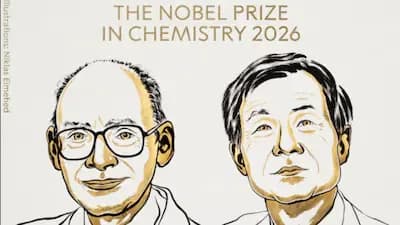
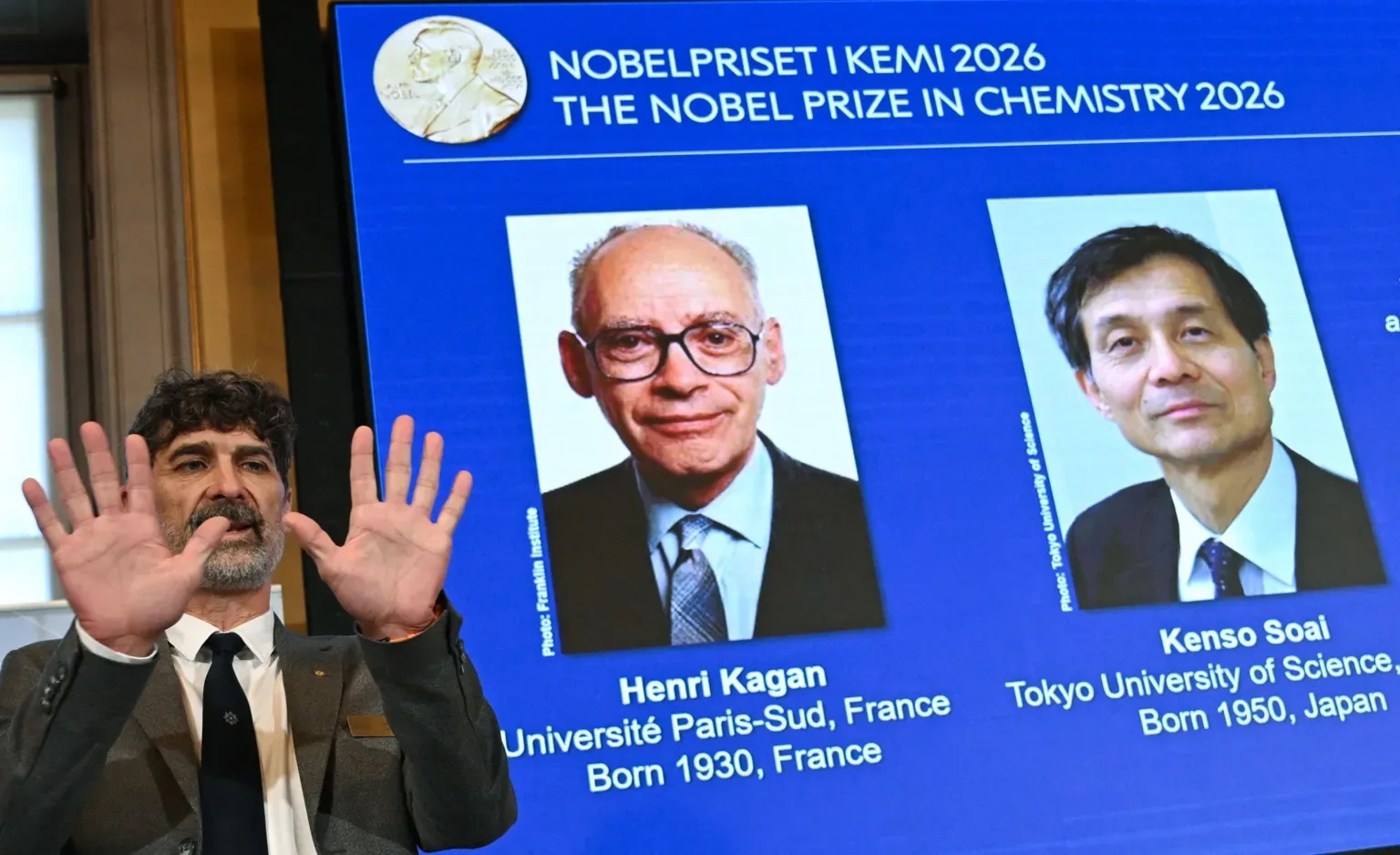
The Nobel Prize in Chemistry has been awarded to French scientist Henri B. Kagan and Japanese chemist Kenso Soai for their groundbreaking work on one of chemistry’s most fundamental mysteries: why life uses predominantly one version of certain molecules over its mirror image.
The phenomenon, known as chirality, describes molecules that exist in two forms that are mirror images of one another. Much like a person’s left and right hands, these molecules may look similar but cannot be perfectly superimposed.
 Chirality is particularly important in biology because living organisms generally use only one of the two possible forms of many essential molecules. Amino acids, for example, are the building blocks of proteins and exist in different mirror-image forms, but life on Earth predominantly relies on one specific form.
Why Molecular Chirality Matters
Under ordinary laboratory conditions, many chemical reactions produce approximately equal amounts of both mirror-image forms. Scientists have therefore faced a longstanding challenge: how can a chemical reaction be controlled so that it produces predominantly or exclusively the desired form?
This question is particularly significant in pharmaceutical science. Different molecular forms can interact differently with biological systems. One form of a compound may have therapeutic effects, while its mirror image may be inactive or potentially harmful.
The history of thalidomide illustrates the consequences of this problem. The drug was prescribed in the 1950s to pregnant women experiencing morning sickness. Its molecular structure contains chiral forms, and the drug’s effects demonstrated the serious consequences that can arise when different molecular forms interact differently with the human body.
A Century-Old Chemical Mystery
Kagan’s work in 1986 demonstrated a new method of influencing chemical reactions to produce an excess of one molecular form over the other. His research opened new possibilities for controlling molecular chirality.
Soai subsequently advanced the field. In 1995, he reported a chemical reaction with the potential to produce a single chiral form of an organic molecule. By 2003, his research had demonstrated control over a reaction in which only one of the two possible mirror-image forms was produced.
The achievement represented a major step toward reproducing, in the laboratory, the type of molecular selectivity observed in nature.
Implications for Medicine and Forensic Science
The ability to control molecular chirality has significant implications for drug development, toxicology, biochemistry and forensic science.
In forensic investigations, understanding how different molecular forms behave can be important when analysing drugs, poisons, biological samples and other chemical evidence. Enantiomers the two mirror-image forms of a chiral molecule can differ in their biological effects, metabolism and distribution within the body.
This makes stereochemical analysis relevant to the interpretation of toxicological findings and the identification of substances encountered in forensic investigations.
The research also provides insight into a much broader biological question: why life itself developed a preference for one molecular orientation.
Scientists studying chirality have noted that this molecular “handedness” extends into biological structures and processes. The phenomenon can be observed at different levels of biological organisation, from the molecular building blocks of life to structures such as the asymmetric arrangement of organs and the coiling patterns of snail shells.
The Nobel Committee described the research as addressing a chemical mystery that has existed for more than a century: how homochirality, the selective production and use of one molecular form, can emerge.
The discovery offers scientists a powerful way to reproduce this selectivity under controlled laboratory conditions and strengthens our understanding of one of the fundamental principles underlying chemistry and life itself.