
When we think about forensic science, we often think of DNA profiles, fingerprints, toxicology reports, questioned documents, weapons and digital evidence.
But behind the growth of forensic science in India are scientists who spent decades building something larger- laboratories, expertise, training systems and institutions capable of bringing science closer to criminal investigation and justice.
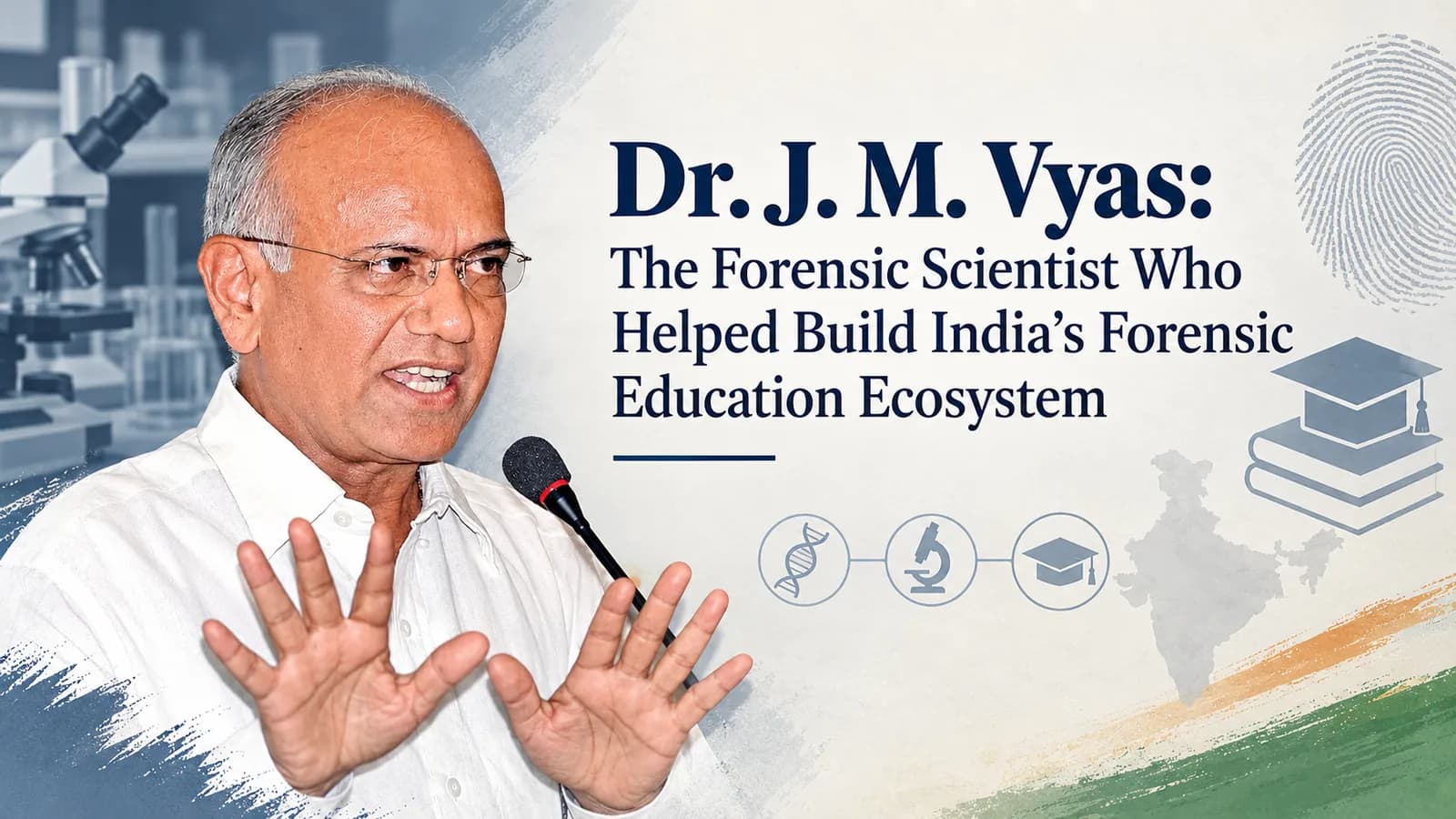
One of the most prominent names in that journey is Dr. J. M. Vyas, an internationally recognised forensic scientist and the founder Vice-Chancellor of the institution that became the National Forensic Sciences University (NFSU)*.
His professional journey spans more than five decades and closely follows the evolution of forensic science in Gujarat and India.
From Junagadh to Forensic Science
Dr. Jayant Maganbhai Vyas, popularly known as Dr. J. M. Vyas, was born on 6 November 1951 in Junagadh, Gujarat.
He completed his early education in Junagadh and pursued his higher education in Gujarat. He completed his graduation from Saurashtra University in 1971 and his post-graduation in 1973.
His academic qualifications include M.Sc., Ph.D. and LL.B., giving him an interdisciplinary academic background combining science, advanced research and law.
This combination of scientific and legal education became particularly relevant to his career at the intersection of scientific evidence, criminal investigation and the justice system.
The Beginning of a Five-Decade Forensic Journey
The year 1973 marked an important turning point in Dr. Vyas’s professional life.
He joined Gujarat’s forensic science system at a time when forensic science was still developing as a specialised field in India.
Over the years, he worked across forensic science and administration, eventually becoming the Director of the Directorate of Forensic Science, Gujarat State, in 1993.
His work extended beyond laboratory examination. He was involved in strengthening forensic capabilities, professional training and the use of scientific methods in criminal investigation.
His career gradually developed from that of a forensic scientist into that of an institution builder.
Recognition for Forensic Service
Dr. Vyas’s contribution to forensic science and criminal investigation received several recognitions during his career.
In 1997, he received the President’s Police Medal for Meritorious Service.
In 2004, he was recognised as the Best Forensic Science Laboratory Director of the country and received a commendation certificate at the 15th All India Forensic Science Conference.
In 2008, he received a Lifetime Achievement Award in Forensic Chemistry from Amity University and AIIMS, New Delhi.
These recognitions reflected his contribution not only to forensic laboratory work but also to the broader development of forensic science in India.
Building University Around Forensic Science
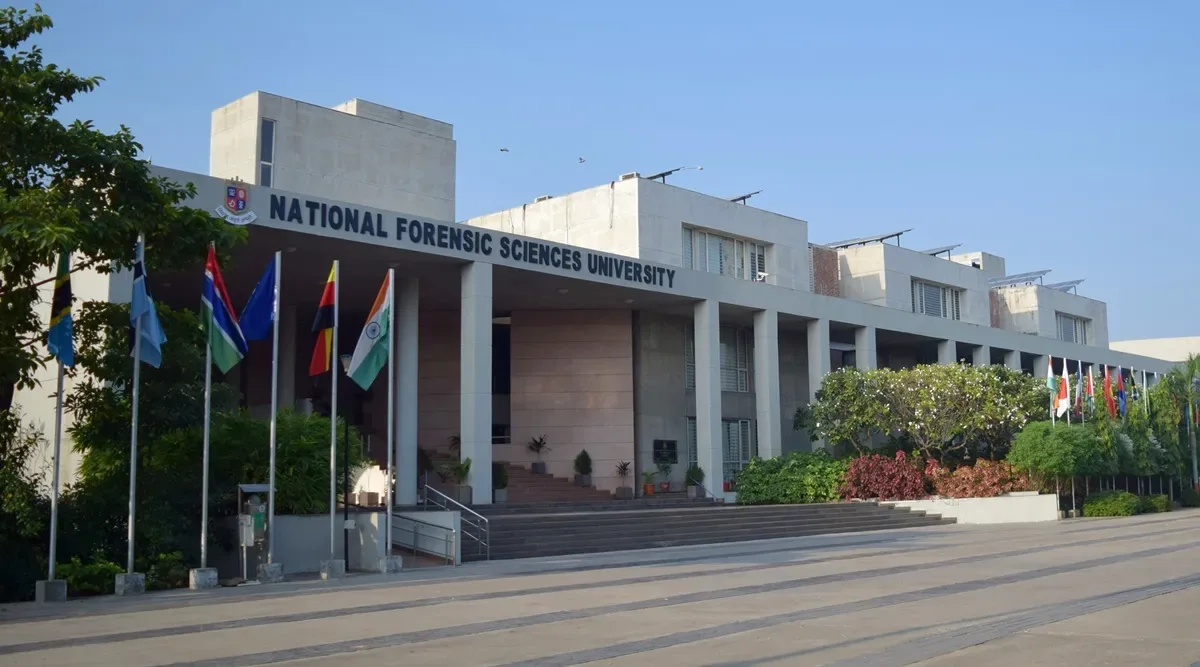
A defining chapter in Dr. Vyas’s career began in 2009, when Gujarat established the Gujarat Forensic Sciences University (GFSU).
Dr. Vyas became its founder Director General and later served as its Vice-Chancellor.
The vision went beyond creating another academic institution.
The objective was to bring together forensic education, research, training, professional development and practical exposure within a specialised university environment.
The institution also expanded into areas connected with national security and investigation.
In 2013, a Master’s programme in Homeland Security and Anti-Terrorism was introduced, reflecting the broader concept of using forensic and allied scientific capabilities for prevention and security.
This approach represented a shift from viewing forensic science only as a laboratory discipline to understanding it as part of a much larger investigative and security ecosystem.
From GFSU to National Forensic Sciences University
A major milestone came in 2020, when Gujarat Forensic Sciences University was transformed into the National Forensic Sciences University.
NFSU became an Institution of National Importance under the Ministry of Home Affairs.
Dr. J. M. Vyas became the founder Vice-Chancellor of the national university.
The transformation significantly expanded the institution’s role.
The focus was no longer limited to Gujarat. The university was positioned to contribute to forensic education, research, training and professional capacity-building at the national and international levels.
Expanding the Scope of Forensic Science
During Dr. Vyas’s institutional leadership, forensic science was increasingly connected with areas such as policing, security, homeland security and emerging technologies.
The broader institutional vision recognised that forensic science does not operate in isolation.
A forensic laboratory may produce scientific findings, but those findings become meaningful within a larger justice system involving investigators, police officers, prosecutors, lawyers and courts.
This multidisciplinary approach became an important feature of the forensic education ecosystem associated with NFSU.
An International Forensic Presence
Dr. Vyas’s work also extended beyond India.
He was associated with the INTERPOL Forensic Science Symposium Organising Committee and served in international forensic science forums.
His international recognitions include the Distinguished International Forensic Scientist Award from the Henry C. Lee Institute of Forensic Science at the University of New Haven in 2018.
In 2019, he received a Lifetime Achievement Award from the International Association of Police Academies (INTERPA), Turkey.
These engagements helped connect Indian forensic education and professional expertise with the wider international forensic community.
The Padma Shri
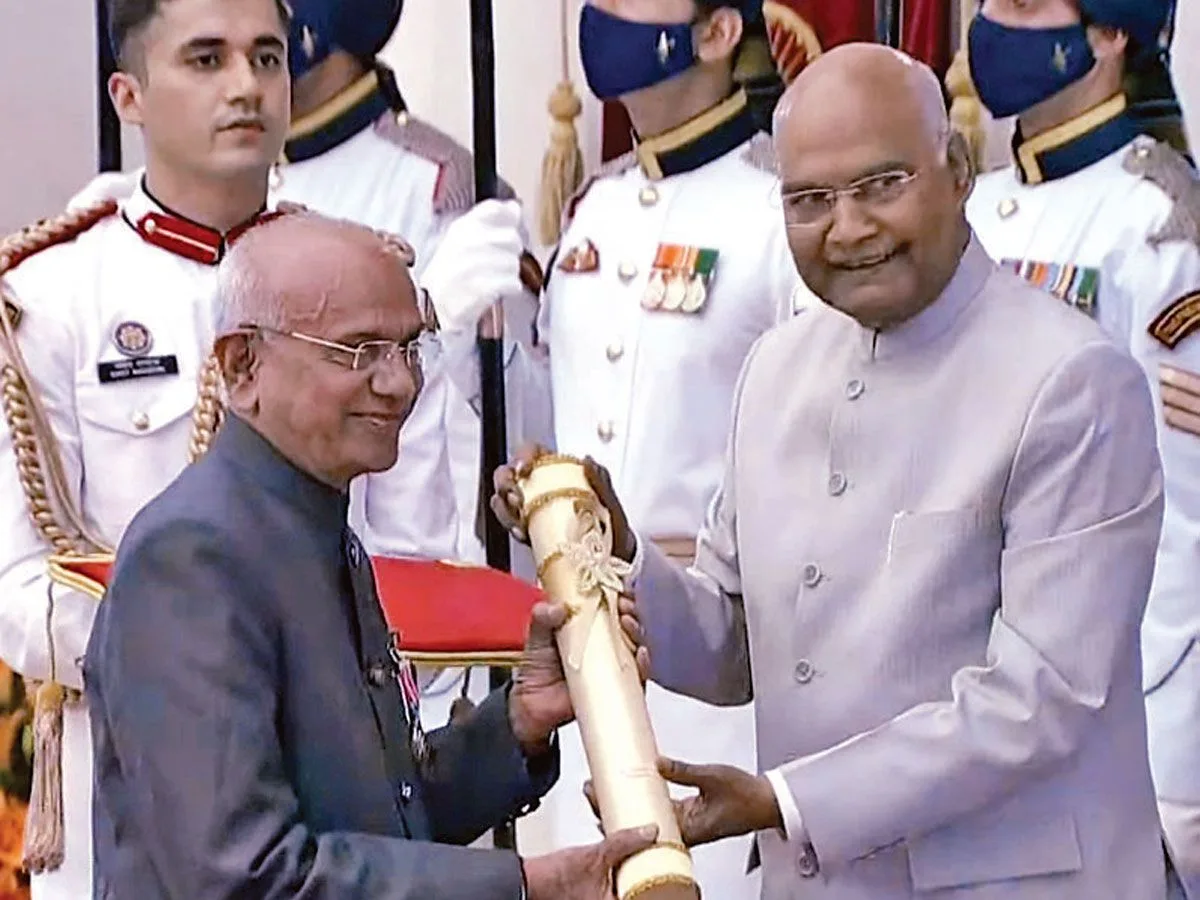 In 2022, Dr. J. M. Vyas received one of India’s highest civilian honours — the Padma Shri.
He was honoured in the Science and Engineering category for his contribution to the field.
The recognition came after decades of work in forensic investigation, forensic administration, education, research and institution building.
By this stage, his career had moved far beyond the role of an individual forensic scientist.
He had become part of the larger story of how forensic science was being institutionalised and expanded in India.
The Digital Transformation of Forensics
The forensic landscape has changed dramatically during Dr. Vyas’s career.
When he began working in the 1970s, forensic investigation was largely centred on traditional disciplines such as chemistry, biology, toxicology, questioned documents and fingerprints.
Today, investigators increasingly deal with smartphones, computers, cloud data, cybercrime, digital communications and electronically stored evidence.
The forensic education ecosystem associated with NFSU has consequently expanded into emerging areas such as cyber and digital forensics.
In January 2024, a digital forensic laboratory was inaugurated at the NFSU Gandhinagar campus through a collaboration between the Directorate General of GST Intelligence (DGGI) and NFSU.
The initiative was aimed at strengthening digital forensic capabilities, including areas such as mobile and computer forensics.
It reflects how forensic science has moved from the traditional crime laboratory into the digital environment.
More Than a Scientist — An Institution Builder
The most significant part of Dr. J. M. Vyas’s story may not be a single investigation, scientific technique or award.
It is his institution-building journey.
From entering Gujarat’s forensic science system in the early 1970s, to becoming Director of the Directorate of Forensic Science, to helping establish Gujarat Forensic Sciences University, and eventually becoming the founding Vice-Chancellor of the National Forensic Sciences University, his career has closely followed the expansion of forensic science in India.
His academic background in science, research and law, combined with decades of forensic administration, training and professional experience, placed him at a unique intersection of disciplines.
And perhaps that is one of the most important lessons from his career.
Forensic science is not only about examining evidence after a crime. It is also about building the scientific, educational and institutional capacity required to make evidence meaningful in the justice system.
From Junagadh to the leadership of a national institution dedicated to forensic sciences, Dr. J. M. Vyas’s journey represents a significant chapter in India’s transition toward science-driven investigation and forensic education.
His legacy can be seen not only in the honours he received, but also in the institutions, programmes, professionals and forensic capabilities that developed during his decades of service.