
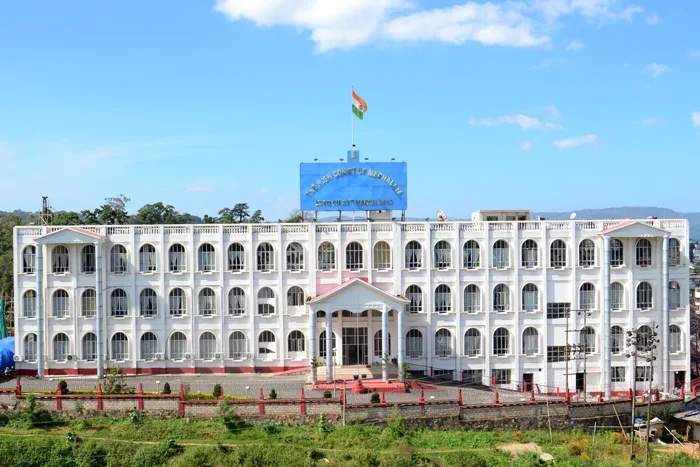
The Meghalaya High Court has directed the state government to urgently address infrastructure deficiencies, staff shortages and equipment failures at the Directorate of Forensic Sciences Laboratory in Shillong. The court warned that delays and deficiencies in forensic examinations could affect criminal investigations, chargesheet preparation and court trials, potentially resulting in acquittals.
High Court Raises Concerns Over Forensic Laboratory Conditions
The Meghalaya High Court has expressed serious concern over the condition and operational capacity of the state's Forensic Sciences Laboratory (FSL) in Shillong.
A division bench comprising Chief Justice Revati Mohite Dere and Justice W Diengdoh issued directions after examining an inspection report submitted by advocate K. Ch. Gautam, who was appointed as amicus curiae to assist the court.
The report highlighted several shortcomings at the Directorate of Forensic Sciences Laboratory, including inadequate infrastructure, poor sanitation, insufficient scientific personnel and a shortage of essential laboratory equipment.
The court observed that weaknesses in forensic infrastructure and manpower could delay scientific examinations, investigations, preparation of chargesheets and criminal trials. It also cautioned that deficiencies in forensic reports could potentially lead to acquittals.
Shortage of Scientific and Technical Personnel Across Divisions
The inspection report identified significant vacancies and manpower shortages across several specialised divisions of the laboratory, including:
- Chemistry
- Biology and DNA
- Questioned Documents
- Cyber Forensics
- Ballistics
- Physics The report also highlighted vacancies in the gazetted cadre, including two Deputy Director posts and two Scientific Officer posts.
The court expressed particular concern over the functioning of the Cyber Forensics Unit, where one Scientific Officer, assisted by only one staff member, was reportedly managing the unit while also handling the Physics Division.
The shortage of laboratory bearers and other support personnel was another concern, as these employees are essential for handling exhibits, maintaining laboratory spaces and supporting scientific operations.
Poor Infrastructure and Inadequate Maintenance
The amicus curiae's report also highlighted the poor maintenance of the laboratory building.
Several sections of the three-storeyed facility reportedly had damp walls and inadequate sanitation. The establishment was found to have only one cleaner for the entire building, leaving scientific and technical personnel to undertake additional maintenance responsibilities.
The court stressed that proper maintenance and adequate support staff are essential for maintaining a suitable working environment in a specialised scientific institution.
Equipment Failures Disrupt DNA and Chemical Analysis
The laboratory is also facing shortages of essential equipment, chemicals and consumables, affecting its ability to conduct several forensic examinations.
According to the inspection report:
- Chemistry Division: Non-functional equipment has affected laboratory operations and disrupted NDPS testing.
- Biology/DNA Division: Shortages of chemicals and essential consumables have affected DNA examination activities.
- Cyber Forensics Unit: Updated hardware and software are required to strengthen digital forensic investigations.
- Documents and Physics Divisions: Modern scientific equipment is needed to improve examination capabilities.
- Other divisions: Regular maintenance and calibration of scientific instruments remain necessary.
The court was informed that DNA testing had previously been halted because essential chemicals and consumables were unavailable.
The state government informed the bench that procurement of DNA consumables was underway and that the technical evaluation of participating firms had been completed. However, the related procurement proposal was still awaiting government approval.
Non-Functional Generator Raises Concerns Over Laboratory Operations
The court also examined the failure of the laboratory's backup generator, which was installed in 2024.
The generator reportedly became non-functional following a high-voltage surge from the main power supply. The Directorate had submitted a request on September 23, 2026, seeking approval for its repair or replacement.
However, the proposal remained pending before the state government.
The court observed that a reliable backup power supply is essential for forensic laboratories because sophisticated scientific instruments require uninterrupted electricity. Frequent power interruptions could disrupt laboratory operations, affect data security and compromise the functioning of sensitive equipment.
High Court Directs Government to Take Immediate Action
After considering the inspection findings, the High Court directed the Additional Advocate General to place the amicus curiae's report before the Secretary and Joint Secretary of the Home (Police) Department to facilitate prompt decisions on pending approvals and other administrative issues.
The court also issued several directions to the state government:
- Fill existing vacancies, including scientific, technical and Grade-IV support staff positions, at the earliest.
- Prioritise the maintenance and upkeep of the forensic laboratory building.
- Address pending approvals concerning laboratory equipment and essential consumables.
- Take appropriate steps to restore or replace the non-functional backup generator.
- Consider engaging retired FSL employees on a contractual basis, if necessary, until regular appointments are completed. The court further directed the state government to pay Rs. 50,000 to amicus curiae K. Ch. Gautam for his assistance and contribution to the proceedings.
Government Asked to Submit Action-Taken Report
The High Court directed the Additional Advocate General to file an affidavit detailing the steps taken by the state government to address the deficiencies identified in the inspection report.
The matter has been listed for further hearing on November 19, 2026, when the court will examine the government's response concerning staff recruitment, equipment procurement, laboratory maintenance, essential consumables and power backup arrangements.
Forensic Perspective: Infrastructure Shortages Can Affect the Administration of Justice
The developments in Meghalaya highlight a critical challenge facing forensic science infrastructure in India: the gap between the increasing dependence of criminal investigations on scientific evidence and the operational capacity of forensic laboratories.
Modern criminal investigations frequently rely on DNA profiling, chemical analysis, questioned document examination, ballistics and digital forensic analysis. Delays in these examinations can affect the collection, interpretation and presentation of scientific evidence before courts.
A shortage of qualified forensic personnel can increase laboratory backlogs, while outdated equipment and unavailable consumables may prevent laboratories from conducting essential examinations.
The situation also highlights the importance of maintaining uninterrupted power supplies, properly calibrated instruments, adequate laboratory infrastructure and specialised technical supervision.
Forensic evidence must be scientifically reliable, timely and properly documented. Strengthening forensic laboratories is therefore not merely an administrative requirement but an essential component of an effective criminal justice system.
The Meghalaya High Court's intervention brings attention to the need for sustained investment in forensic infrastructure, scientific personnel and technological capabilities to ensure that forensic evidence can effectively support the delivery of justice.