
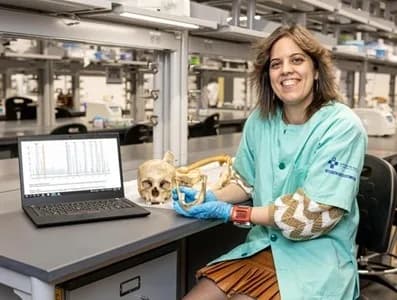
Sara C. Zapico is a forensic scientist and assistant professor in NJIT’s Department of Chemistry and Environmental Science. Her work sits at the intersection of scientific research, forensic science and education, giving students an opportunity to understand how scientific principles are applied to real-world forensic investigations.
Forensic science education has become increasingly important as crime investigation continues to incorporate developments in areas such as DNA analysis, analytical chemistry, toxicology, digital evidence and other scientific disciplines.
University-level forensic science programmes play an important role in preparing students to work with evidence in a manner that is scientifically sound and suitable for use within the criminal justice system. Educators therefore have a critical role not only in teaching scientific concepts but also in developing students’ understanding of evidence interpretation, laboratory practices and the limitations of forensic conclusions.
Recognition for contribution to forensic education
The Senator John Cornyn III National Higher Education Forensic Science Educator of the Year award highlights the contribution of educators who help strengthen forensic science education and prepare the next generation of forensic professionals.
Zapico’s recognition reflects the importance of academic leadership in a field that continues to evolve with advances in science and technology.
For students pursuing careers in forensic science, educators serve as an important link between classroom learning and professional practice. Their work can help students develop the scientific reasoning, laboratory skills and critical thinking required when examining evidence associated with criminal investigations.
Why forensic science educators matter
Forensic evidence can play a significant role in criminal investigations and court proceedings. However, the value of such evidence depends heavily on the quality of the underlying scientific examination, interpretation and communication.
This makes forensic science education an important component of the wider justice system. Well-trained forensic professionals must understand not only how to conduct scientific examinations but also how to evaluate findings objectively, recognise uncertainty and communicate conclusions responsibly.
Recognition of educators such as Zapico therefore goes beyond an individual academic achievement. It also draws attention to the people responsible for developing the scientific expertise of future forensic scientists.
A growing field of scientific education
The forensic sciences continue to expand as new technologies and scientific methods become available to investigators and laboratories. At the same time, the field faces the continuing need for properly trained professionals who can apply these techniques while maintaining scientific reliability and integrity.
Academic institutions such as NJIT contribute to this development by bringing together scientific education, research and forensic applications.
Zapico’s 2026 recognition highlights the role that educators and universities play in this process and underscores the importance of investing in the next generation of forensic science professionals.