
The Incident
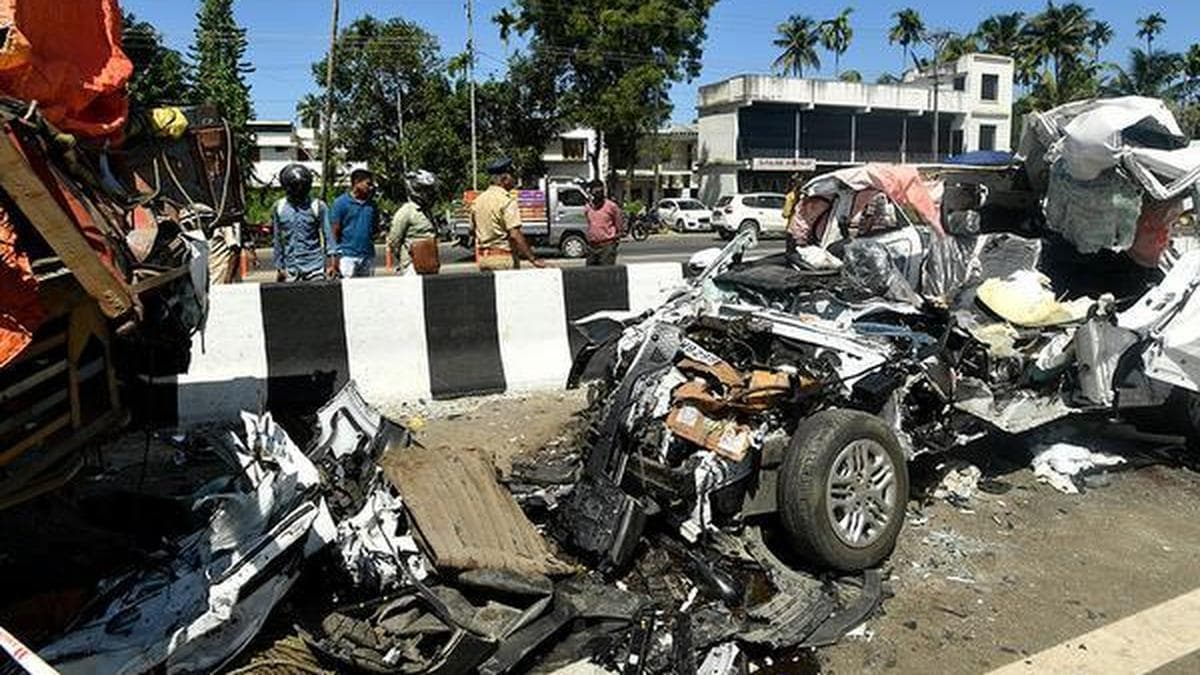
On the night of September 4, a car carrying engineering students from a college in Dindigul, Tamil Nadu, slammed into a lorry parked on the Kaipamangalam stretch of NH-66 in Thrissur, Kerala. The high-speed impact killed all eight occupants. The victims were traveling from Guruvayur toward Kodungallur when the crash occurred.
What the Autopsy Found
Autopsies conducted by the forensic wing of Thrissur Medical College revealed injuries consistent with a high-impact collision — extensive trauma to the head and chest pointing to excessive speed at the time of impact. More notably for investigators, examiners also detected a strong smell of alcohol in seven of the eight bodies, with preliminary findings suggesting the students may have consumed liquor within one to two hours before the crash.
The Forensic Caveat
Dr. Hitesh Shankar, who heads the Forensic Medicine Department at Thrissur Government Medical College and supervised the post-mortems, was careful to frame the finding in context rather than as a verdict. He noted that while alcohol can impair a driver’s judgment, attention, reaction time, coordination, and perception of speed and distance — all of which raise crash risk — its mere presence in the blood does not by itself establish that it caused the accident. Blood samples have since been sent for detailed laboratory analysis to quantify alcohol levels and to check for any narcotics or other intoxicants.

Building the Timeline
The toxicology angle is only one thread investigators are pulling. Police are also probing reports of an altercation between the students and local residents at Thalikkulam earlier the same night, and are reviewing CCTV footage to reconstruct the group’s movements before the crash. Reports indicate the altercation took place at Pathamkallu while the students were searching for accommodation, roughly 15 kilometres from the crash site. Adding to the complexity, college authorities and the students’ families were apparently unaware of the trip’s actual itinerary, with conflicting accounts of whether the group was headed to Kodungallur or Kochi.
Why This Matters Forensically
This case is a textbook example of how post-mortem toxicology and injury-pattern analysis work together — and where their limits lie. A “spirituous odour” or a positive alcohol reading tells investigators about the physiological state of the deceased, but establishing causation in a crash requires correlating that data with speed reconstruction, vehicle damage analysis, and behavioral evidence like the reported altercation. The pending lab confirmation on alcohol quantification — and the added screen for narcotics — will be central to whatever conclusion the investigation ultimately reaches.