
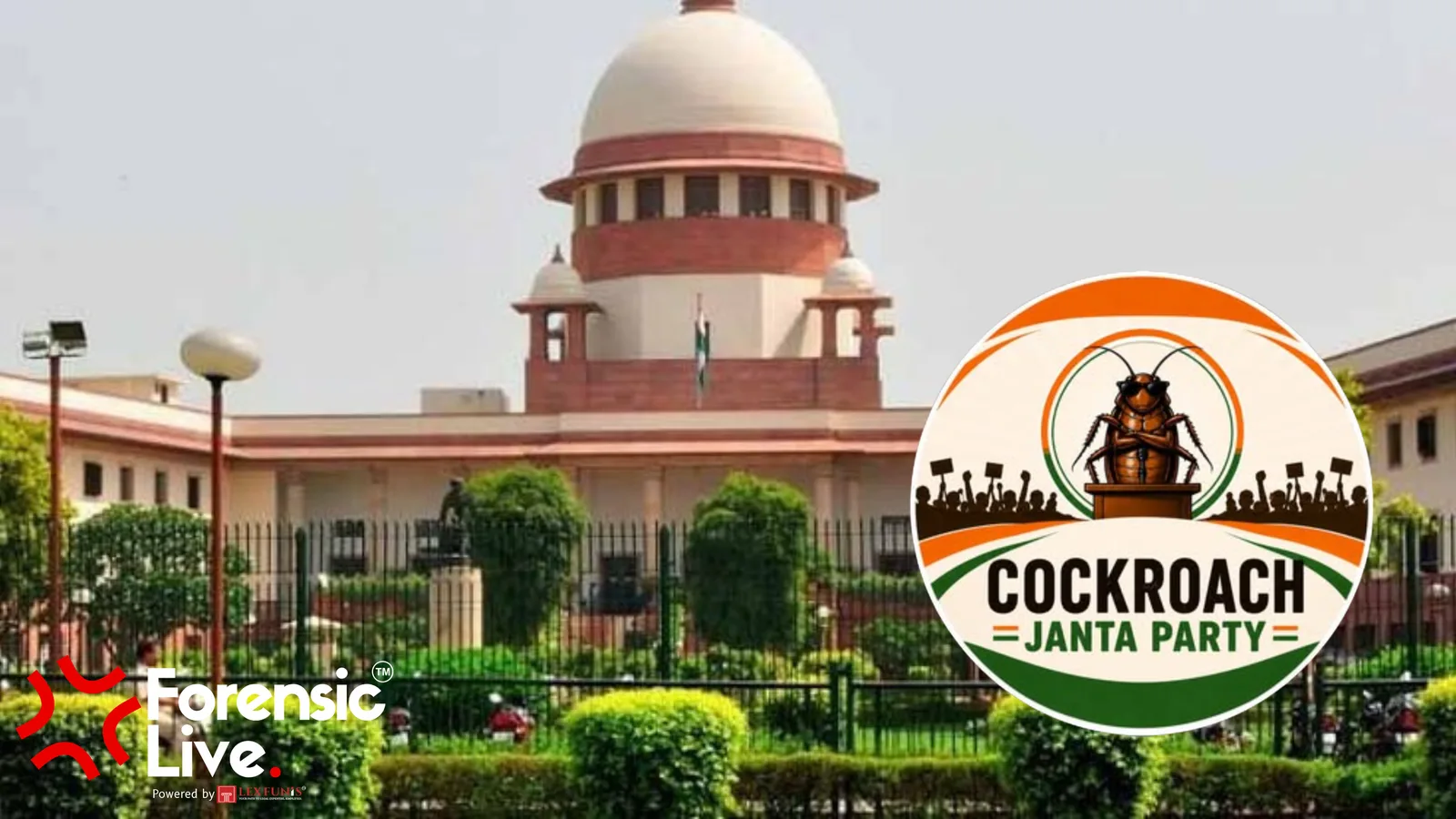
The Supreme Court on Wednesday took serious note of a notice issued by the Greater Noida Executive Magistrate to a student of Gautam Buddha University in connection with protests associated with the Cockroach Janata Party (CJP). The notice required the student to explain why he should not be bound by a personal bond of ₹5 lakh, along with two sureties of an equivalent amount, purportedly to ensure maintenance of peace.
The development assumes significance because the notice was issued only three days after the Supreme Court’s September 1, 2026 order, in which the Court had directed the closure of FIRs arising from student protests held between July 20 and 25 over alleged NEET-UG 2026 examination irregularities and directed that no fresh FIRs be registered in relation to those protest incidents.
What Is the Case About?
The petitioner, Akshat Tripathi, a second-year student at Gautam Buddha University, approached the Supreme Court challenging the notice issued by the Greater Noida Executive Magistrate on September 4, 2026.
According to the petition, the authorities alleged that Tripathi had been encouraging fellow university students to participate in a proposed CJP dharna and that his activities could disturb public peace.
The proceedings were initiated under provisions of the Bharatiya Nagarik Suraksha Sanhita (BNSS) concerning preventive action. The notice called upon him to show cause why he should not be required to execute a ₹5 lakh personal bond with two sureties of ₹5 lakh each for maintaining peace for six months.
Importantly, the ₹5 lakh amount was proposed as a preventive peace bond and was not a fine imposed on the student. The distinction is legally significant because a bond is intended to operate as a preventive measure rather than punishment for an established offence.

Student Says Notice Circumvents Supreme Court’s Order
In his petition, Tripathi argued that the proceedings violated his fundamental rights under Articles 14, 19 and 21 of the Constitution.
His principal argument is that the September 4 notice came immediately after the Supreme Court’s September 1 directions concerning the CJP-linked student protests. According to the petition, using preventive proceedings against an individual student for the same underlying protest activity would effectively allow authorities to achieve indirectly what the Supreme Court’s order had prevented them from doing directly.
The petition therefore characterises the proceedings as a possible attempt to circumvent the binding directions of the Supreme Court through proceedings before an Executive Magistrate.
Supreme Court Reacts Strongly
The issue was brought before a Bench comprising Chief Justice of India Surya Kant, Justice Joymalya Bagchi and Justice V. Mohana.
During the hearing, the Bench expressed considerable surprise over the issuance of the notice.
Chief Justice Surya Kant questioned how the Executive Magistrate could issue such a notice when the Supreme Court had already passed a clear order concerning action against students involved in the protests. The CJI reportedly observed that the Court’s September 1 directions were clear and that even a layperson could understand them.
The Bench was also informed that the notice had subsequently been withdrawn.
However, the withdrawal did not end the Court’s concern.
The petitioner’s counsel argued that the withdrawal could not erase the alleged violation of the Supreme Court’s order and described the episode as having wider implications for students across the country.
The Supreme Court directed that the relevant facts be placed on record and indicated that it would seek an explanation from the concerned District Magistrate.
What Did the Police Allegedly Say?
The police report cited in connection with the proceedings allegedly accused Tripathi of spreading anti-government” and misleading statements among university students and provoking them to participate in a proposed protest.
Authorities reportedly expressed apprehension that his activities could create tension and potentially disturb public order.
Tripathi, however, has denied the allegations.
He has maintained that he was not even present at the university during the relevant period. According to reports, the university campus had been closed and classes had shifted online, while he was in Prayagraj/Allahabad during July.
Why the September 1 Supreme Court Order Matters
The present controversy cannot be understood separately from the Supreme Court’s September 1 ruling.
On September 1, the Supreme Court invoked its extraordinary powers under Article 142 of the Constitution and ordered the closure/quashing of FIRs connected with student protests held between July 20 and 25 over alleged NEET-UG 2026 paper-leak irregularities.
The Court directed that the cases should not be pursued or investigated and extended the relief to similar FIRs across the country. It also directed that no State or Union Territory should register fresh FIRs relating to the specified protest incidents.
There was, however, an important exception concerning individuals with serious criminal antecedents in connection with the Jantar Mantar proceedings.
The Court described its Article 142 intervention as being based on the peculiar facts and circumstances of the case and clarified that the order should not be treated as a precedent.
A Larger Question: Preventive Powers vs. Right to Protest
The Greater Noida episode raises a broader constitutional and legal question: To what extent can preventive powers be exercised against students in relation to peaceful protest activity, particularly after the Supreme Court has already issued protective directions concerning the underlying protests?
Preventive provisions under the BNSS are designed to address situations where authorities apprehend a possible breach of peace. However, their use against students engaged in political or public protest inevitably raises questions concerning the constitutional protection of freedom of speech and expression and the right to peaceful assembly.
The Supreme Court’s intervention suggests that the Court is closely examining whether executive authorities are complying with the spirit as well as the wording of its September 1 directions.
Notice Withdrawn, But Controversy Continues
Although the Greater Noida authorities reportedly withdrew the notice, the matter has not necessarily ended.
The Supreme Court has indicated that it wants the circumstances surrounding the notice to be formally placed on record and that an explanation may be sought from the District Magistrate.
The case could therefore become significant beyond the individual student involved. It touches upon the authority of Supreme Court orders, limits of preventive executive action, student activism and the constitutional protection available to peaceful protesters.