

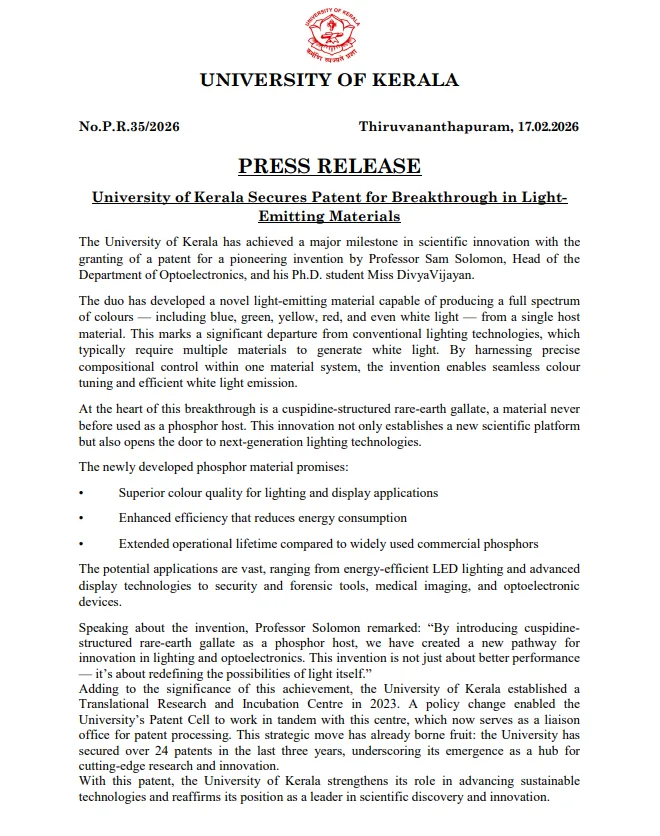
Thiruvananthapuram, Kerala | Researchers at the University of Kerala have developed a novel nanomaterial-based technique to improve the detection of latent fingerprints, potentially offering forensic investigators a new way to visualise faint fingerprint impressions that are difficult to detect using conventional methods.
The technique involves a specially prepared rare-earth-based nanomaterial that emits red light when exposed to ultraviolet (UV) radiation. This optical property helps enhance the visibility of fingerprint patterns deposited on surfaces.
The research was led by Dr Sam Solomon from the Department of Optoelectronics, in collaboration with research scholar Divya Vijayan.
How Does the New Technique Work?
The method uses a light-emitting material known as a nanophosphor. The material is applied to a surface suspected of containing latent fingerprints, where its particles interact with the residue left behind by the fingers.
When exposed to ultraviolet light, the nanomaterial absorbs the radiation and produces a characteristic red emission in the visible spectrum. This fluorescence makes otherwise faint fingerprint impressions easier to observe and examine.
According to the researchers, the nanoscale size of the particles is particularly important because it allows them to adhere more readily to the fine details of fingerprint residue.
Another advantage is that the material's excitation wavelength is compatible with commercially available UV lamps, potentially making the technique easier to adapt to existing laboratory equipment.
Patented Preparation Method
The researchers have obtained a patent for the method used to prepare the compound. The patent specifically covers the synthesis process rather than the compound itself.
The development involved testing different material compositions and optimising preparation conditions. Researchers also examined the material's structural, morphological and photoluminescent properties before conducting experiments to demonstrate its potential for latent fingerprint visualisation.
The research and development process reportedly took approximately six months.
Potential Applications in Forensic Science
Latent fingerprints are often recovered from crime scenes, but their visualisation can be challenging depending on the surface, environmental conditions and the quantity and condition of fingerprint residue.
The newly developed nanomaterial could potentially offer an alternative approach for enhancing faint fingerprint impressions. Its compatibility with commonly available UV lamps may also be useful in considering future forensic applications.
However, the technique has not yet been established for routine forensic casework. The researchers are exploring commercialisation, while independent testing by forensic science laboratories remains an important next step to establish its practical effectiveness.
Significance for Forensic Investigation
The development reflects the growing application of nanotechnology in forensic science, particularly in latent fingerprint detection.
Conventional fingerprint development techniques include powder dusting, chemical reagents and fluorescent methods. Although these techniques remain widely used, researchers continue to explore nanomaterials that may improve sensitivity, contrast and visualisation of fingerprint ridge details.
If independently validated and successfully commercialised, the University of Kerala's development could contribute another tool to the evolving field of forensic fingerprint examination.