
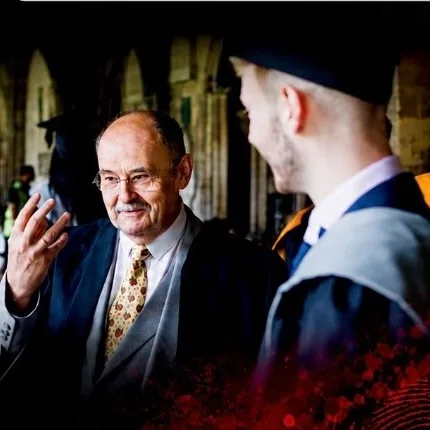
From forensic science policy in the United Kingdom to international capacity-building and forensic education in India, Professor Robert Green has built a career connecting scientific expertise with justice, institutional development and academic excellence.
Professor Robert Green OBE, JP, MA, MSc, M.Litt and DMS is an established figure in forensic science whose career spans academia, government advisory roles, professional practice and international consultancy. Through his work in forensic science education, operational improvement, policy development and international cooperation, he has contributed to strengthening forensic capabilities across institutions and jurisdictions.
At the University of Kent, Professor Green serves as Chair in Forensic Science and Lead for Internationalisation within the School of Natural Sciences. His professional journey reflects a sustained commitment to integrating practical forensic expertise with academic learning, improving institutional performance and promoting the effective use of science in criminal investigations and the administration of justice.
From Professional Practice to Academic Leadership
Professor Green’s association with the University of Kent began in 2001, initially on a part-time basis while he continued to hold full-time positions with the UK Home Office and the Forensic Science Service. He moved into a full-time academic appointment in 2012, bringing extensive professional and governmental experience into higher education.
His academic qualifications include an M.Litt. from the University of St Andrews, an MA and MSc with distinction from Canterbury Christ Church University, a Postgraduate Diploma in Management with distinction, and a Forensic Science Society Diploma awarded through the Chartered Society of Forensic Sciences. In 2021, he also attained Senior Fellowship of the Higher Education Academy, recognising his contribution to higher education teaching and professional development.
At Kent, Professor Green has held several leadership positions, including Professor and Director of Student Engagement and Director of Undergraduate Studies, a role he held from 2012 to 2020. His work has focused on student retention, academic progression and the quality of the learning experience.
A significant aspect of his academic leadership has been the development of the university’s forensic science programme. Under his leadership and through wider departmental efforts, the programme rose to third place nationally in the Complete University Guide rankings, while achieving strong student satisfaction results in the National Student Survey. His approach has emphasised the importance of connecting scientific theory with the realities of professional forensic practice.
In 2025, Professor Green was appointed Distinguished Professor as adjunct faculty at the National Forensic Science University (NFSU), Gandhinagar. That same year, he received the University Teaching Prize at the University of Kent, further recognising his contribution to teaching and academic development.
Shaping Forensic Science Policy and Operational Practice in the UK
Before moving into full-time academia, Professor Green held important positions within the UK’s forensic science and public-sector landscape.
From 1999 to 2002, he worked with the Forensic Science Service, contributing to initiatives designed to improve scientific productivity and operational performance. Among these was the Scientific Work Improvement Modelling (SWIM) programme, which focused on improving the efficiency of forensic science processes.
He also supported the national rollout of the National Ballistics Intelligence Service (NABIS), an initiative intended to strengthen the collection, analysis and use of ballistic intelligence. His work extended to advising on biometric legislation, including engagement with governmental stakeholders in the United States, Canada and the European Union.
Between 2002 and 2010, Professor Green led the Science and Technology Division at the Home Office’s Police Standards Unit. His responsibilities involved the application of science and technology to policing standards and performance improvement.
He subsequently served as Programme Leader at the University of Greenwich from 2010 to 2012, where he guided the university’s forensic science programme towards accreditation by the relevant professional body.
These experiences illustrate how forensic science extends beyond laboratory analysis. Its effectiveness also depends on sound policy, reliable operational systems, professional standards and the appropriate integration of scientific intelligence into investigative practice.
International Consultancy and Forensic Capacity-Building
Professor Green’s work has extended across several countries, with a particular focus on developing sustainable forensic services, strengthening quality frameworks and supporting institutional reform.
One of his notable international assignments involved work with the European Commission and Egyptian authorities between 2013 and 2014, followed by a return visit in 2025. This work focused on reforming forensic medical services and developing sustainable quality frameworks for clinical, pathology, toxicology and DNA services.
He also led a government-published review of forensic science services for the EU delegation and Egypt’s Ministry of Justice. The work addressed institutional arrangements and the development of forensic services capable of supporting criminal investigations and justice systems.
His wider consultancy experience includes advisory work involving forensic services in Kazakhstan, Pakistan and Calgary, as well as more recent engagements in Southeast Asia and the Philippines. He has also contributed to work in Ethiopia alongside the UK Department for International Development and undertaken professional engagement in Northern Ireland.
Since 2024, he has provided ongoing input to the British High Commission in Goa, reflecting the continuing importance of international cooperation in the development of forensic capabilities.
Strengthening Forensic Science Education and Collaboration in India
India has been a significant area of Professor Green’s international engagement since 2018. His work has included more than 60 mentorship and tailored training engagements, alongside support for institutional development and professional knowledge exchange.
Among his contributions has been support for government workshops in Goa addressing forensic responses to sexual and gender-based violence. Such initiatives highlight the importance of effective forensic evidence collection, appropriate examination procedures, professional training and coordinated responses to sensitive criminal investigations.
Professor Green has also been involved in cooperation agreements with the National Forensic Science University, Manav Rachna University and SGT University, Gurugram. These partnerships provide a foundation for academic exchange, professional development and wider collaboration in forensic science education and practice.
His appointment as Distinguished Professor at NFSU, Gandhinagar, in 2025 further reflects the connection between his international experience and India’s growing forensic science education ecosystem.
Forensic science education benefits considerably from such international engagement. Exposure to established practices, comparative approaches to forensic service delivery and collaboration between universities and practitioners can help students and professionals understand how scientific evidence is generated, evaluated and presented within different legal systems.
Teaching at the Intersection of Science and Practice
Teaching remains a central component of Professor Green’s contribution to forensic science. At the University of Kent, he has taught across a range of undergraduate and postgraduate modules, covering both foundational concepts and advanced professional applications.
His teaching portfolio has included Skills for Forensic Scientists, Introduction to Forensic Science, Fibres and Microscopy, Advanced Topics in Forensic Science, DNA Analysis and Interpretation, and Incident Management.
These subjects span several essential dimensions of forensic work, from the examination and interpretation of physical and biological evidence to the management of incidents and the broader investigative process.
By incorporating professional experience into academic teaching, Professor Green’s approach seeks to help students understand not only the scientific principles underlying forensic techniques but also the operational and evidential considerations that shape their application.
Student evaluations cited in his professional profile indicate ratings averaging between 4.2 and 4.5 out of five in recent assessments. These results reflect positive student feedback on his teaching and the value of connecting classroom learning with professional experience.
Professional Recognition and Contributions to the Forensic Community
Professor Green’s contributions have been recognised through several professional honours and appointments.
In 2010, he was appointed an Officer of the Most Excellent Order of the British Empire (OBE) by HM Queen Elizabeth II for services to forensic science. He is also a Fellow of the Chartered Society of Forensic Sciences, having served as the society’s Vice President from 2021 to 2024 and as Honorary Secretary.
In 2024, he received a Lifetime Achievement Award from the International Association of Scientists and Researchers.
His professional activities have included participation in major scientific and policing conferences. In 2025, these engagements included the All India Conference on Forensic Science, the India Police Chiefs’ Conference in Raipur, and international forensic medicine conferences in Turkey and Egypt. His professional profile also records planned keynote engagements in India and the Philippines for 2026.
Beyond these activities, Professor Green has served as an external examiner at a range of higher education institutions, including the universities of St Andrews, Teesside, Strathclyde, Keele and Bath Spa, as well as the American University of Beirut and the University of Lancashire. His experience as a grant assessor for organisations including the UK Engineering and Physical Sciences Research Council, the US National Institute of Justice and the Swedish Research Council has further connected him with research evaluation and scientific development.
He has also communicated forensic science to wider audiences through broadcast documentaries, including Sky TV productions such as Britain’s Most Evil Killers and Saturday Night Strangler, as well as podcasts.
Why His Work Matters to the Future of Forensic Science
The development of effective forensic science systems requires more than advanced laboratory equipment or new analytical technologies. It also depends on skilled professionals, sound quality assurance, responsible scientific interpretation, effective institutional management and sustained investment in education.
Professor Robert Green’s career brings together these interconnected areas. His experience across government, forensic service delivery, higher education and international consultancy demonstrates the importance of collaboration between scientific institutions, policing bodies, universities and policymakers.
His engagement with Indian institutions is particularly relevant as the country continues to develop its forensic science education, training and investigative infrastructure. International knowledge exchange can help strengthen professional competencies and encourage dialogue around quality standards, evidence interpretation and the practical challenges of forensic service delivery.
Ultimately, the value of forensic science lies in its ability to provide reliable, scientifically grounded evidence that assists investigations and supports fair judicial outcomes. Building that capacity requires not only scientific innovation but also strong institutions and well-trained professionals.
Through his work in teaching, policy, professional development and international cooperation, Professor Green’s career illustrates how these elements can come together to advance forensic science and its contribution to justice.
Forensic Live recognises the importance of professionals whose work connects forensic science education, institutional development and the practical application of scientific evidence. Their experiences offer valuable perspectives for students, researchers and practitioners working to strengthen the future of forensic science.