
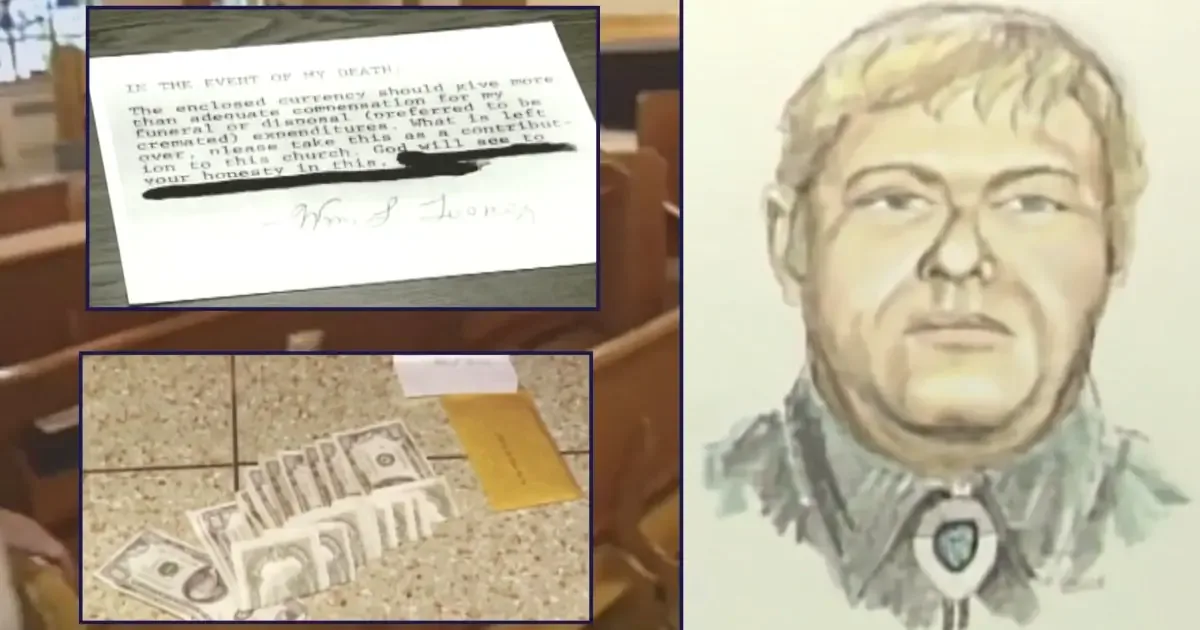
After more than four decades, investigators have finally identified a mysterious man whose death inside an Idaho church in 1982 had remained an unidentified-person case. Previously known only as the “Unknown Wanderer,” the man has now been identified as Dr. Mathew Francis Betkouski, a chemist whose background has also prompted investigators to examine a possible connection to the infamous 1982 Chicago Tylenol murders.
The 1982 Death That Remained a Mystery
On December 4, 1982, a man was found dead inside Sacred Heart Catholic Church in Boise, Idaho. Investigators determined that he had died after ingesting cyanide.
He was carrying approximately $1,900 in cash, a wallet without identifying documents, two key rings containing nearly 30 keys, a watch and other personal belongings.
Investigators also discovered a typed note signed using the name “Wm. L. Toomey.” The name was later determined to be an alias. Despite an extensive investigation, authorities were unable to establish his identity, and he was eventually buried as an unidentified man.
The case remained unresolved for decades before being reopened in 2019.
A Key Became a Major Investigative Lead
One of the most important clues came from the collection of keys found among the man’s belongings.
Investigators revisiting the evidence noticed that one of the keys contained markings associated with a hardware store in Jacksonville, Florida. Further examination of the key and its engraving led investigators to a property on Mills Court in Jacksonville.
Historical property records revealed a connection to a man who had disappeared from the area in 1982 and was later declared dead in absentia.
Investigators eventually located the man’s surviving brother in Los Angeles and obtained a DNA sample from him.
DNA recovered from the Unknown Wanderer’s belongings was compared with the relative’s sample. The analysis established a familial relationship and ultimately helped investigators identify the unidentified man as Dr. Mathew Francis Betkouski.
Who Was Mathew Betkouski?
Investigators say Betkouski had a background in chemistry and had worked in several scientific and industrial environments.
His professional history included work associated with chemical and fragrance research as well as employment at Lockheed Martin’s White Sands facility in New Mexico.
Investigators also uncovered accounts from people who knew him suggesting that he had an interest in poisons and cyanide. Some reportedly recalled conversations in which he discussed the possibility of using poison to commit what he described as a “perfect crime.”
His scientific knowledge and interest in toxic substances have become particularly significant because of another major event that occurred in the United States in the same year.
The Possible Connection to the Tylenol Murders
In September 1982, seven people in the Chicago area died after consuming Extra-Strength Tylenol capsules that had been contaminated with potassium cyanide.
The deaths triggered nationwide fear and led to massive changes in the way pharmaceutical products were packaged and protected against tampering.
Following Betkouski’s identification, investigators discovered several details that prompted them to examine whether he could have had any connection to the killings.
Among the evidence associated with Betkouski were a hand-drawn map of Chicago and materials related to cyanide. Investigators also learned about his previous interest in poisons and his discussions involving cyanide.
Authorities further determined that Betkouski had been in Chicago in late 1981, months before the Tylenol deaths.
However, investigators have not established that he was in the Chicago area when the seven poisonings occurred in September 1982.
For that reason, authorities have not publicly identified Betkouski as a suspect in the Tylenol murders.
The Cyanide Evidence
Another important detail concerns the type of cyanide discovered among Betkouski’s belongings.
Investigators found sodium cyanide, while the poison used in the Tylenol killings was potassium cyanide.
The two substances are chemically different. Therefore, the discovery of sodium cyanide does not by itself establish that Betkouski was responsible for the Chicago poisonings.
Similarly, the presence of a Chicago map among his belongings does not independently prove a connection to the murders.
Investigators are continuing to examine the available evidence, including his movements, personal history and activities around 1982.
A Cold Case Solved Through Modern Forensics
The identification of the Unknown Wanderer demonstrates how modern forensic methods can breathe new life into decades-old investigations.
The breakthrough was not based on a single piece of evidence. Instead, investigators combined old physical evidence with modern DNA analysis, familial comparison, property records and renewed examination of previously overlooked clues.
A key recovered more than 40 years ago helped investigators trace a possible location. Historical records helped establish a connection to a missing person, while familial DNA provided the scientific evidence needed to confirm the man’s identity.
The case also illustrates the growing role of genetic genealogy and familial DNA investigations in identifying unidentified remains and resolving long-standing cold cases.
Investigation Into the Tylenol Murders Continues
Following the identification, information from the Idaho investigation has been shared with authorities in Illinois, where investigators are examining whether any credible connection exists between Betkouski and the 1982 Tylenol deaths.
At present, the identification of Betkouski solves one mystery but does not solve the Tylenol murders.
There is currently no publicly established forensic evidence proving that Betkouski was responsible for the seven deaths.
The investigation therefore remains open, with authorities continuing to examine the historical evidence surrounding both cases.